1.
Explain why Voices in The Park is an example of a postmodern picturebook.
Voices in the Park is an example of
a postmodern picturebook because the story is told from multiple points of view
(polyphonic), the story narrative is differentiated by shifts in these
different points of view, there are postmodern framing devices used such as the
characters telling their story within the story, the typography of each
character's point of view are different from the other, and finally, there were
elements of known masterpieces in the work (the couple dancing, the Mona Lisa
and another portrait leaning against the wall, and the red poppy
flower).
2.
Give examples of how at least three of the picture book codes listed on pg 78
are used in Voices In The Park.
- Codes of Perspective: The children under the trees talking to each other just before the boy was called to go home.
- Codes of Color: Smudge and her father walk out of the city to the park and it is colored in oranges, blacks, and greys.
- Codes of Position and Size: The part where the mother shouts looking for her son. The mother is positioned in the center and is much larger than the tiny trees and landscape in the background.
 3. Identify and explain the type of "interplay" between the written word and visual images on one of the pages in Voices In The Park.The part of the story when the dad takes the black and white dog to the park. In the picture it shows the dog's tail wagging and ready to run. The text that is with this image says "He loves it there." This is an example of an enhancing interplay.
 Another example of interplay present is symmetrical interplay. This can be viewed in the picture where the children took off their coats and played on the monkey bars.
 4. Identify the art movement or technique that is being used in Voices In The Park.This book illustrates various hints towards multiple art movements. The two movements that are most prominent are impressionism and surrealism. Both of these movements were used in different ways that somewhat stretch the literal definition of each movement.Impressionism: In the book, impressionism is reflected in the colors and the objects that those colors are perceived as. For instance, the flowers in the distance could be flowers or they could be other people in the park.Surrealism: In the book, surrealism is shown through the character's images of the park. For instance, the dad may be somewhat bored or depressed and in his version of the park, the colors are darker and not what they should be in reality, i.e. the park trees are black and his overall point of view is darker.5. Conduct an Ideological Analysis and Structural Analysis of Voices In The Park. What is the message? Provide evidence from the images to support your opinion. Use the examples on pg 86, 87,89. I do not expect your analysis to be as in-depth but I would like for you to make two or three insightful observations about the perspectives and social context conveyed through the books words and images.Ideological AnalysisThe ideological message from Voices in the Park can be complex. A couple insights pertains to the characters themselves and their suggested economic well being. First, the story is not about people, but about gorillas. This fact suggests that the author, Browne, avoided using race to suggest any stereotypes or preconceived notions about the characters. Secondly, the fact that the mother and son appear to be wealthier than the dad and daughter shows each families economic stance. It is also interesting that the wealthy mother's point of view is read first, and the poor daughter's point of view is last. This story could also represent happiness as it is connected to money. For example, the wealthy characters depict the park in more colorful and vibrant colors than the poor family members do. This color change could also indicated the level of each families happiness as it is reflected in their voices and their view of the world.Structural AnalysisThe structural message is to be broken down into three subcategories: interpersonal, compositional, and ideational.From the perspective of the interpersonal, the characters are shown in various settings within the park, as full body images, and as zoomed in images of the characters. The children characters interact with each other while the parents are only shown together with some distance between them, indicating no communication. The overall look of the book is fantastical, with the characters being gorillas, but realistic as the setting and events are rooted in reality.From the perspective of composition, the characters are often shown moving from left to right on the pages, in the center of the pages, on the left side of the pages, and the text making up the right side of the pages. The use of a border is clearly defined in the majority of the book.From the perspective of ideational, the characters are shown from different geographical locations which can suggest poor and rich characters. Also, the dress of the characters can sway the view to determine which characters are wealthy and which are poor.6. Embed a picture of the cover of Voices In The Park in your blog.


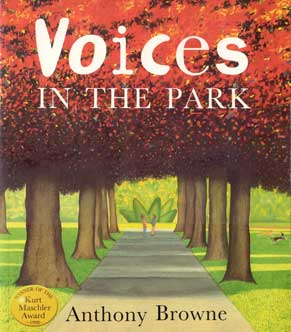

Our ideological analysis were similar in the fact that we both realized that the author was relating to the different types of socioeconomic classes. I also liked how you explained how the author used gorillas to avoid using a certain race in the story. This was an excellent point made. When reading your structural analysis, I liked how you explained the three different categories thoroughly. We both believed that the borders played a significant role in the book as well as explained how some of the characters interacted where as some of the characters did not interact. This was one similarity.
ReplyDeleteGina,
ReplyDeleteI found your analysis of the postmodern picture book interesting and enlightening. Your reference to how the author used gorillas instead of different races of people was thoughtful. I do see how using a specific race of people could be construed as stereotypical. The gorilla gives an unrealistic sense that they aren’t really people but animals. Also, your reference to how the order of the narrations and the concept of how money influences happiness were interesting. I didn’t see that but your point was well put.
I agree with how the position of the characters is relevant to how the author wants us to perceive the point of view of each narrator. The parents are more focused and large images so we as the reader can see them as the center of the story as told by them. In contrast the children are less focused on their situation and seem to have a childlike perspective to see the park as a place to play and frolic in the sunshine while they interact with others.